Key Takeaways:
What is Demand Space?: Demand space analysis maps customer needs by importance and availability to pinpoint white space opportunities.
Use it for: New product development, market entry, and identifying White Space (high-importance, unmet needs).
Common Research Methods: MaxDiff, conjoint, segmentation, and Voice of Customer research.
Outcome: Clear prioritization of innovation efforts and smarter resource allocation.
In the competitive world of product development, success hinges on more than just innovative ideas; it requires a deep understanding of customer demand. Many products fail because companies focus on what they can build rather than what customers actually need. This is where demand space analysis comes in as a powerful framework for identifying customer needs and prioritizing high-growth opportunities.
What Is Demand Space Analysis, and How Can It Uncover White Space Opportunities?
Demand space is a strategic map that plots customer requirements based on two key dimensions derived from customer research:
- Customer-Perceived Importance (Demand): How critical is a specific need or problem for the customer?
- Customer-Perceived Availability (Supply): How well are existing solutions currently meeting that need?
By conducting a specialized customer needs analysis survey, often using advanced methods like MaxDiff scaling, researchers can quantify these factors. Plotting the results creates a visual map with four quadrants.
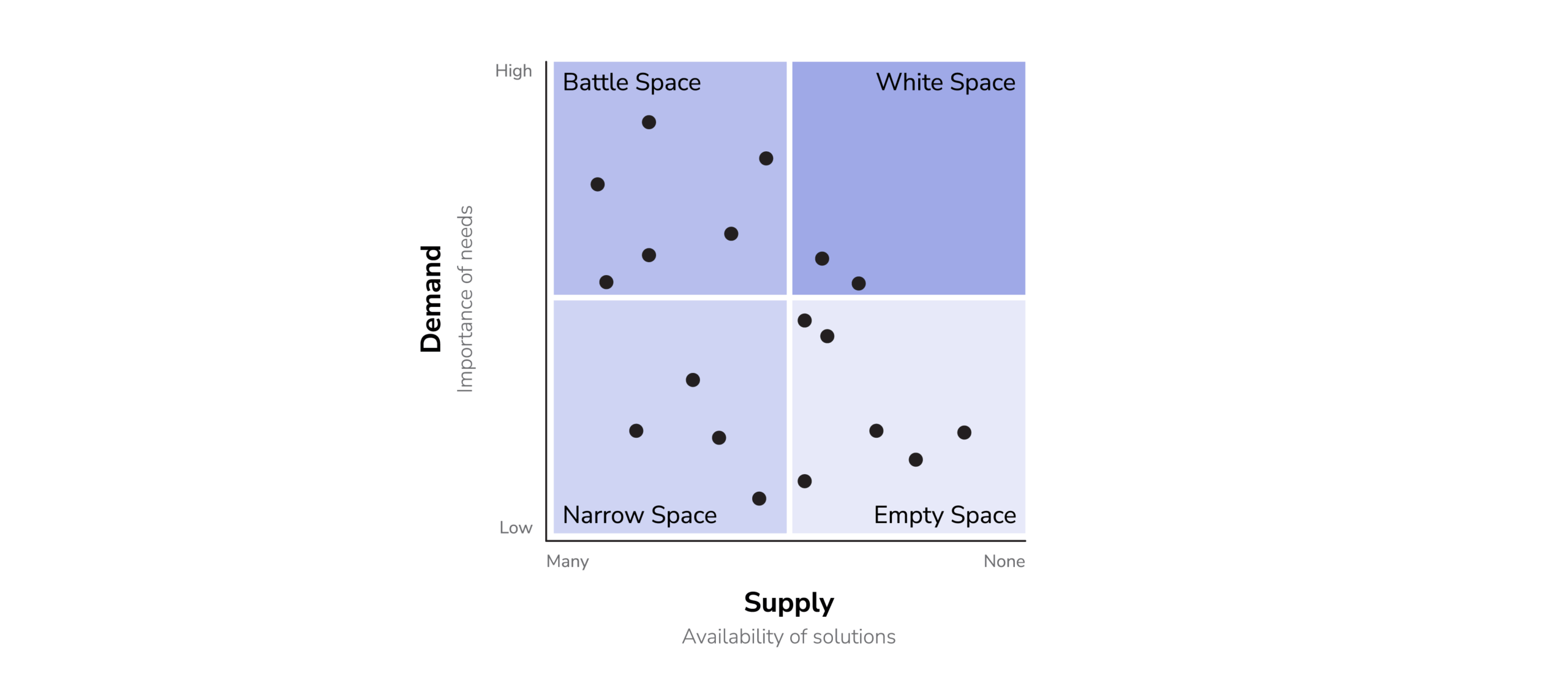
- White space: The most critical quadrant – these needs are highly important but are currently unmet or poorly addressed. White Space analysis is the process of pinpointing these lucrative gaps in the market which represent the ideal launch path for new products and features.
- Battle space: covers more contested opportunities
- Empty space: is a less competitive but also important area
- Narrow space: is contested territory where the stakes tend to be low
When to Use Demand Space Research
This form of market demand research is invaluable at key strategic junctures. It is a cornerstone of effective new product development research and is essential for:
- Prioritizing product innovation efforts: By pinpointing requirements that are both critical and underserved, you can direct resources toward high-potential innovation areas.
- Strategic positioning: The method can be used to fine-tune strategies to create a competitive edge by addressing specific gaps in the market landscape.
- Trend detection and assessment: An exploration of multifaceted customer needs helps organizations stay ahead by investing in solutions for emerging requirements.
Example of Demand Space in Action Using Demand Space to Identify Unmet Customer Needs
A biotech client wanted to launch a new alternative food ingredient and believed two new features would be a breakthrough. An initial B2B panel using demand space methodology revealed a challenge: while the features were seen as unique (unmet), they weren’t top priorities for the overall market.
However, by diving deeper into the consumer behavior research data, the team performed a segmentation analysis. This revealed two distinct customer groups:
- Segment A highly valued the new features, placing them firmly in the White Space.
- Segment B found them unimportant.
This customer demand analysis provided crucial clarity. Instead of a broad, likely unsuccessful launch, the company could focus its product marketing research and launch strategy on the highly receptive Segment A, dramatically increasing its chance of success.
Conclusion: From Assumption to Insight with GLG Demand Space
Relying on internal assumptions about product demand is a risky strategy. GLG Demand Space Analysis provides a disciplined, data-driven framework for growth. By leveraging the right customer-needs-analysis tools and methods, companies can replace guesswork with insight.
This approach ensures that product market research and consumer market research efforts are focused on the highest-value opportunities that are important, unmet customer needs. Whether you’re conducting B2B customer research or broad consumer research, understanding your demand space is the key to building products that customers truly want and driving efficient, successful growth.
Other Recommended Resources:
Discover Customer Preferences with Conjoint Analysis
GLG Case Study: Understanding Research Gaps on Supply and Demand for Alternative Proteins
Understanding MaxDiff Analysis: A Comprehensive Guide